Start here
What “Stage 1” Actually Means
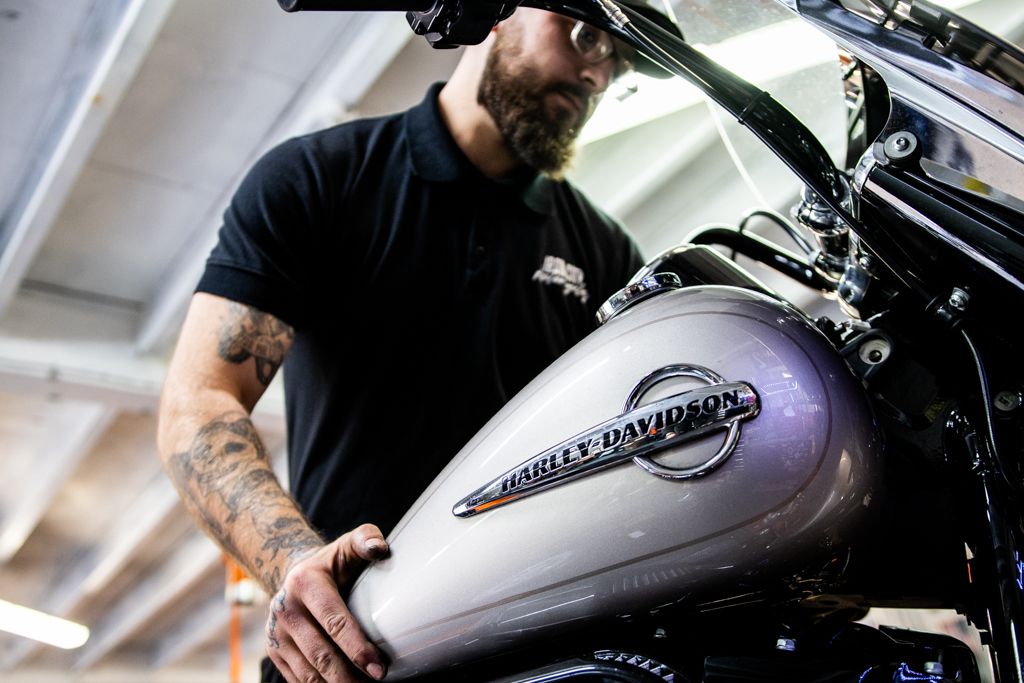
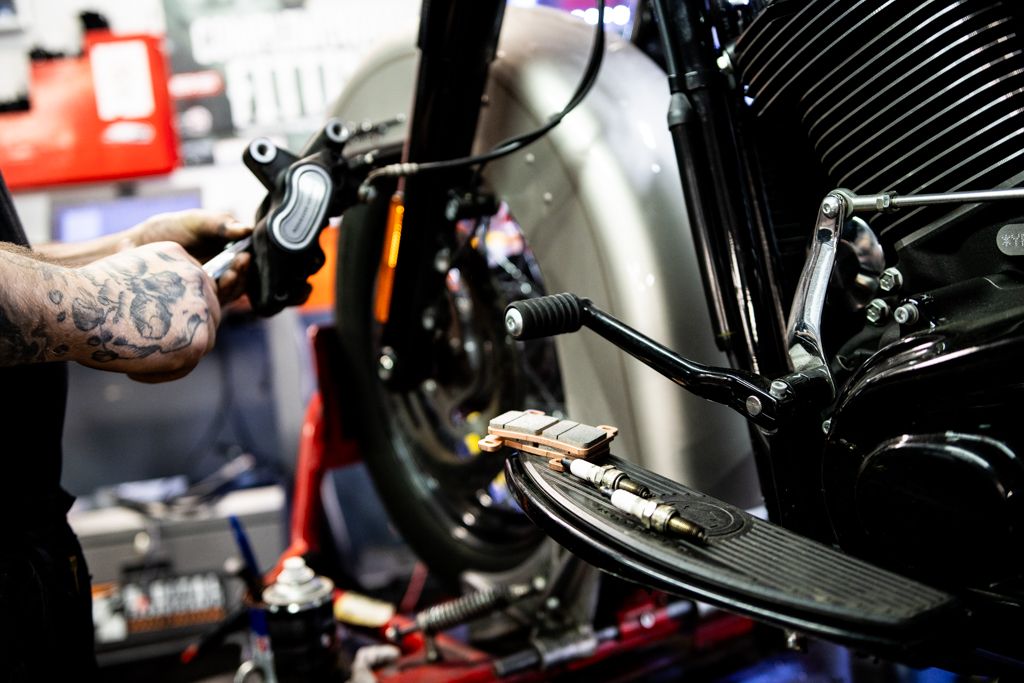
Stage 1 is a Harley-Davidson term and the meaning is narrower than the internet sometimes implies. It is the three-piece upgrade the factory itself sells under the Screamin’ Eagle banner: a high-flow air cleaner, a freer-flowing exhaust, and an ECM tune that tells the bike what you just did. Anything beyond that — cams, big-bore kits, head work — is Stage 2 or above, and it lives on a different page with a different budget.
The reason the three live together is mechanical, not marketing. A modern Harley engine is a closed system that the factory has tuned to meet emissions and noise regulations. The intake is restrictive on purpose, the exhaust has catalytic converters and tight baffles for the same reason, and the ECM map ties the two together at the lean end of what is safe. Pull one of those out and you have not improved the bike, you have just unbalanced it. Pull two and tune the third, and you have done Stage 1.
What you get out of it on a Milwaukee-Eight is mostly mid-range — a useful bump in torque between 3,000 and 4,500 rpm, where you actually ride on a British A-road, plus the audible and tactile change that most owners are really there for. What you do not get is a different bike. A Stage 1 Road Glide is a slightly faster, much better sounding Road Glide. It is not a Road King with a turbo bolted to it, and anyone selling you that story is selling you a story.
Part one
The Air Cleaner
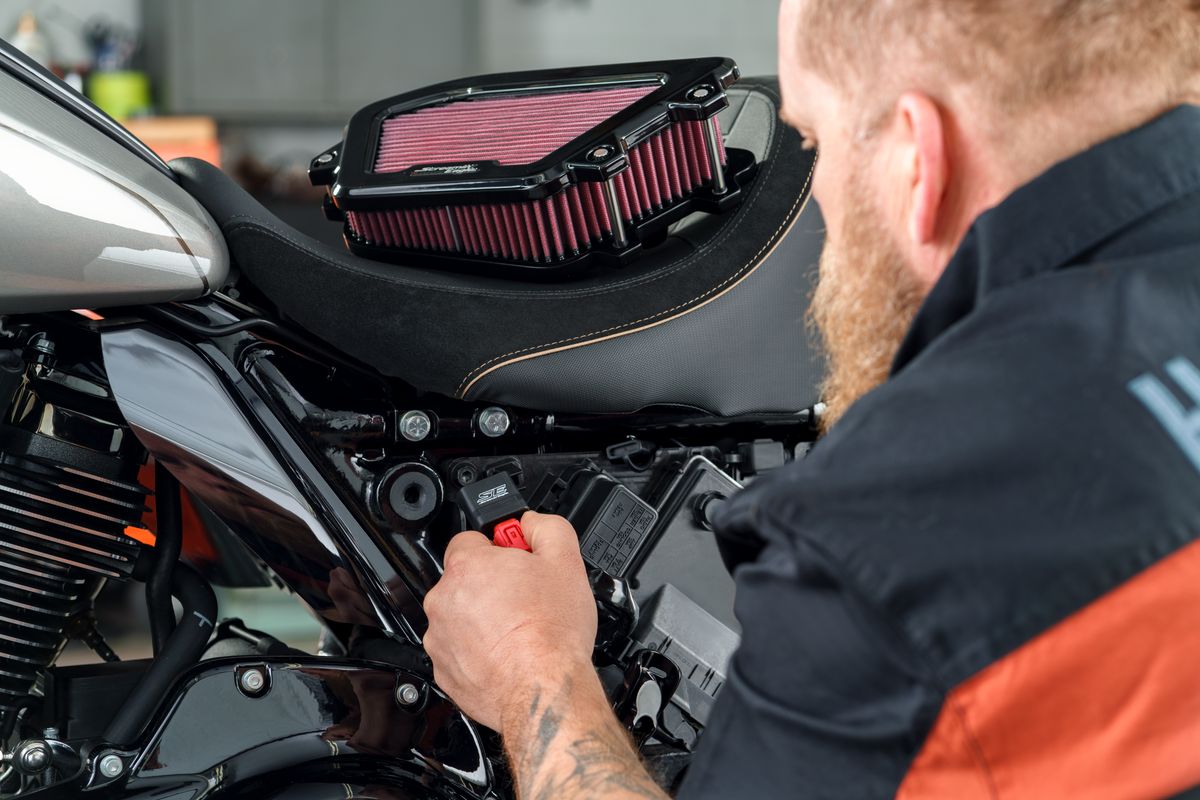
The factory air cleaner on a Milwaukee-Eight is a closed plastic housing tucked in tight to the right of the engine. It is designed around two priorities — keeping intake noise down and meeting Euro 5 — and performance is, at best, the third thing on the list. Swap it for a high-flow open or semi-open element and the engine simply has more air to work with, particularly above 3,000 rpm where the factory restriction starts to bite.
The default UK pick is the Screamin’ Eagle Heavy Breather in its various incarnations, partly because it is the H-D Stage 1 kit part and partly because it works. Outside the official kit, Arlen Ness (Method, Big Sucker), K&N Aircharger kits and S&S Stealth/Air Stinger are all proven on M8 platforms. None of them are bad. The differences are aesthetic, the size of the filter element, and whether you want a visible velocity stack or something that hides under a cover.
Fitment notes worth knowing
On M8 Touring bikes the right-knee clearance matters more than on Softails — a deep open filter can put your knee into the element on a long ride. Most riders are fine with a low-profile design or a backplate kit. On M8 Softails there is more room and you can run a deeper filter without thinking. On older Twin Cam bikes, the same principle applies but the part numbers are different and the gains are larger because the factory intake was tighter still.
Browse air intake parts here — filter by your bike with the Part Finder so you only see what fits.
Part two
The Exhaust
The exhaust is the part people start with, often before they have even read the word Stage 1. There is no shame in that — it is the loudest single change you can make to how a Harley feels — but it is also where the most money gets wasted, because slip-ons and full systems are different decisions and they are not interchangeable.
Slip-ons
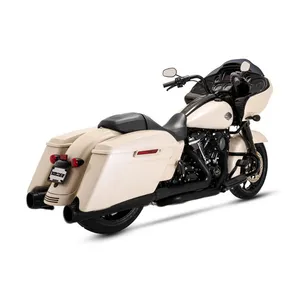
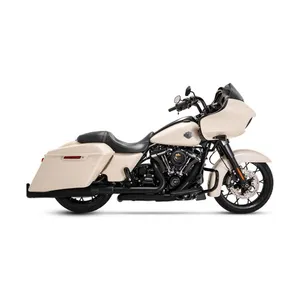
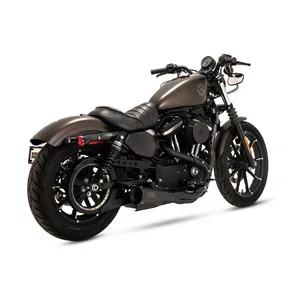
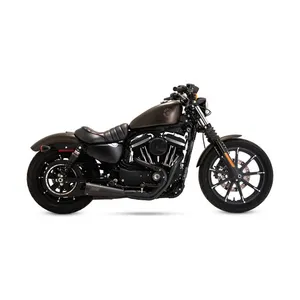
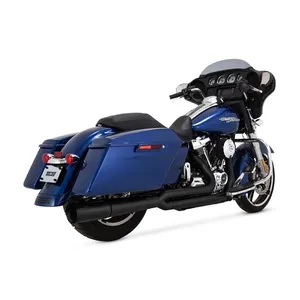
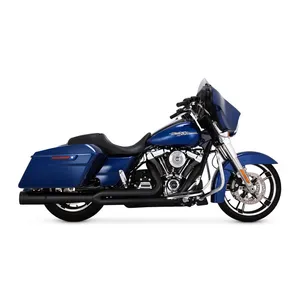
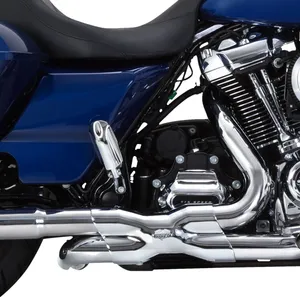
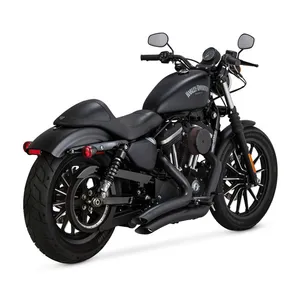
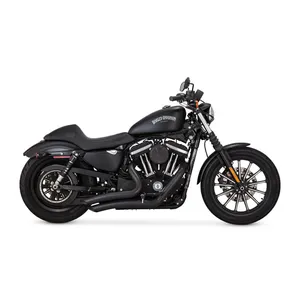
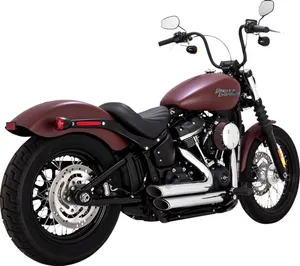
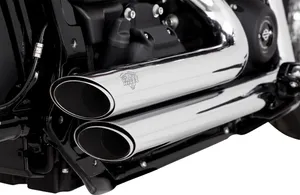
A slip-on replaces only the rear muffler section and clamps onto the standard head pipe. On a modern M8 that means the catalytic converter usually stays, the change is mainly tone and a small mid-range bump, and you can fit it on a Saturday morning with hand tools. Vance & Hines Eliminator 400 and Twin Slash slip-ons are the UK default for a reason — E-marked, road-legal baffles available, and they sound like a Harley should rather than like a leaf blower. S&S Mk45 covers the same ground in a different visual style.
Full 2-into-1 and 2-into-2 systems
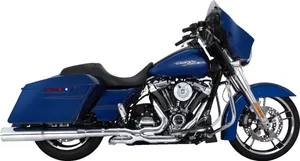
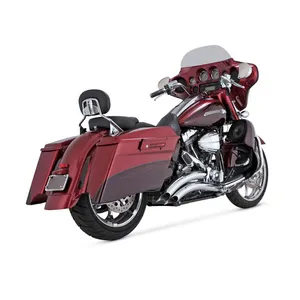
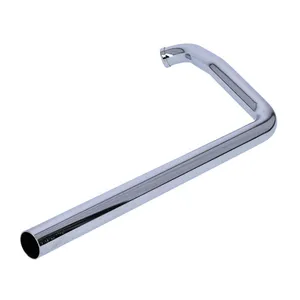
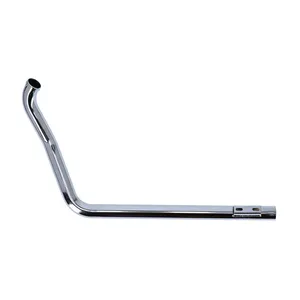
A full system replaces head pipes too. On most designs the cats go with them, which is where the real power and the real volume both come from. Vance & Hines Power Duals headers paired with slip-ons, or a full Hi-Output 2-into-1, will give you the proper torque numbers but you are committing to a tune at the same time — no exceptions, no “I will just ride it for a week.”
UK noise reality
Reputable Stage 1 exhausts will pass a sensible MOT and survive a routine police stop with the right baffles fitted. Open drag pipes will not. If your commute runs past one of the new acoustic cameras springing up in Kensington or central Leeds — and your insurer is the kind that asks awkward questions when something goes wrong — that is worth knowing before you spend the money, not after.
Part three
The ECM Tune
The tune is the part that gets skipped. It is also the only part that, if ignored, can turn a Stage 1 from a fun upgrade into a slow-motion engine problem. The factory ECM map is built for the factory intake and exhaust. Change those without re-mapping and you have a bike that is leaner than it was, hotter than it was, and running closer to detonation than it was — and the rear cylinder, which already runs hotter on an M8, gets the worst of it.
The two paths
Most UK riders go with a handheld tuner that plugs into the diagnostic port and either loads a pre-built map for your exact bike + parts combination, or talks to a dyno operator to build a custom one. The two products you will see again and again are the Screamin’ Eagle Pro Street Tuner and the Dynojet Power Vision (PV4 and PV-Tuner). Both will get the job done. If you bought your bike new from a dealer and want to keep them on side, the SE tuner is the politically easier choice.
Canned map vs dyno tune
A canned map matched to your exact intake and exhaust combination is, on a healthy M8, perfectly fine for most riders — particularly with a slip-on and a high-flow filter. A proper dyno session (£200–£350 at a competent UK shop) gets you the last few percent and, more importantly, confirms the bike is actually safe at full throttle in your altitude and your fuel. The bikes we see most often through Iron Stable are M8 114 Touring and Softail, and on those a quality canned map is genuinely most of the way there. If your Stage 1 is the start of a longer project — cams, big bore, head work — the dyno is not optional and never will be.
See Screamin’ Eagle tuning and performance parts for the H-D-branded route, or Dynojet for the Power Vision family.
The numbers
What to Realistically Expect
Power and torque
A clean Stage 1 on a Milwaukee-Eight 114 typically gives you in the region of +5 to +10 lb-ft of torque and a similar single-digit horsepower gain, with most of the improvement landing in the 3,000–4,500 rpm window. On the M8 117 the percentages are similar but the starting numbers are higher, so it feels meatier. On older Twin Cam 96/103 bikes the gains tend to be a touch larger because the factory restriction was greater. Anyone promising 30% more power from a Stage 1 alone is selling you something.
Cost
UK ballpark for parts: £900–£1,800. A pragmatic specification — Heavy Breather or equivalent, V&H slip-ons, Dynojet Power Vision — lands around £1,200–£1,500. Going to a full 2-into-1, a custom dyno tune, and a premium intake pushes the top end. Doing the official Screamin’ Eagle Stage 1 kit at a dealer, with the tune and labour included, tends to land at the very top of that range or slightly beyond.
Fuel and heat
A properly tuned Stage 1 typically returns fuel economy within a couple of mpg of stock for the same right hand. Engine heat is usually lower, not higher, because the bike is no longer running quite as lean. The way numbers actually fall over is the obvious one: a bike that responds better gets ridden harder.
Warranty
Aftermarket intake and exhaust plus a non-OEM tune can void powertrain warranty on related failures — that is the H-D position, and it is the dealer’s call in practice. If your bike is new and you want to keep coverage clean, the full Screamin’ Eagle Stage 1 kit fitted by a dealer is the safe route. If your bike is out of warranty or you accept the trade-off, the aftermarket route is faster, cheaper and, done properly, completely fine.
By platform
Model-by-Model Notes
Milwaukee-Eight Touring (2017+)
The platform Stage 1 was practically designed for. Road Glide, Street Glide, Electra Glide, Road King — all benefit cleanly. 114 engines are the sweet spot for cost versus gain. On 117 CVO and the post-2023 standard 117, the kit is largely about character; the performance is already there.
Milwaukee-Eight Softail (2018+)
Fat Boy, Heritage, Low Rider, Breakout, Street Bob — same Stage 1 logic as Touring, slightly different part numbers, more clearance for deeper intakes. The 107 in particular wakes up noticeably. Low Rider ST and S owners with the 117 are usually doing Stage 1 for the noise and the throttle response more than the dyno sheet.
Sportster Evolution (1200, pre-2022)
Still very much a Stage 1 candidate, with a long history of established part numbers. Air cleaner gains are real; exhaust gains are mostly tonal; a fuel management tune (Fuelpak FP3 or Power Vision Sport) is essential, not optional.
Revolution Max (Sportster S, Nightster, Pan America)
A different engine entirely — liquid-cooled, much higher revving, much tighter factory tune. Stage 1 here is less standardised and the part ecosystem is younger. Most UK riders running the RevMax 1250 are sticking with slip-ons and an FP3 or Power Vision flash; full system work is a niche pursuit and usually not where the money goes first.
Twin Cam (88, 96, 103, 110)
The classic Stage 1 platform — intake especially gives you a bigger relative gain than on M8 because the factory was tighter. Tune is non-negotiable on the EFI bikes; on the older carb Twin Cams (88/95) you are looking at jet kits rather than ECM flashes.
Not sure where to start? The Part Finder filters by year, model and family. Or browse parts organised by Harley-Davidson model.
Common questions
Frequently Asked Questions
Does a Stage 1 upgrade void my Harley-Davidson warranty?
The honest answer is: it can, and the picture is messier than most people pretend. Harley-Davidson’s position is that modifications affecting the engine, fuel system or exhaust may invalidate the limited warranty on those systems — and dealers are entitled to refuse goodwill claims tied to a failure they can trace back to a non-OEM intake, pipe or tune. If your bike is still under warranty and you ride it hard, the safest route is the Screamin’ Eagle Stage 1 kit through a dealer, where coverage is generally preserved on the tuned components. Aftermarket parts plus a third-party tune is faster and often cheaper, but you carry the risk if something engine-related lets go before the clock runs out.
Is a Stage 1 Harley still UK MOT-legal?
Yes, if you pick parts that are designed for the road and you understand the test. The UK statutory drive-by noise limit for post-2014 bikes is 80dB; the MOT itself does not currently include a static noise test for most motorcycles, but a clearly unsilenced exhaust will get a refusal under emissions and noise discretion, and roadside checks are a separate story. Reputable slip-ons — Vance & Hines Eliminator, S&S Mk45, the Screamin’ Eagle Street Performance line — are sold E-marked or with road-legal baffles for exactly this reason. Open drag pipes are not Stage 1, they are a different decision entirely.
Do I really need to retune the ECM after fitting an intake and exhaust?
Short answer: yes. Not "should consider," not "for best results" — yes. A Milwaukee-Eight from the factory runs lean to meet emissions; bolt on a freer-flowing intake and a less restrictive exhaust and you make that lean condition worse. More heat, snappier throttle response that flatters a problem it is also masking, and over time, valve and piston damage on the rear cylinder in particular. The tune is not the optional extra at the end. It is the part that makes the other two parts safe.
Slip-on mufflers vs a full exhaust system — what is the difference for Stage 1?
Slip-ons replace the rear muffler section only and bolt to the original head pipe. Cheaper, easier, retain the catalytic converter on most modern bikes, and on an M8 they give you most of the audible character with a small but real bump in mid-range. A full 2-into-1 or 2-into-2 system replaces head pipes too, removes the cat in most designs, and unlocks proper performance gains — but you are spending two to three times the money and you absolutely must retune. For a first Stage 1, slip-ons plus a tune is the most common UK path, and frankly the right one for a daily rider.
How much does a Stage 1 upgrade cost in the UK?
Roughly £900 to £1,800 in parts, depending on choices, before any labour. A typical pairing — Screamin’ Eagle Heavy Breather or Arlen Ness Method intake, V&H Eliminator slip-ons, and a Dynojet Power Vision or Fuelpak FP3 — lands in the middle of that range. The official Screamin’ Eagle Stage 1 kit fitted through a dealer, with tune and labour included, sits at the top end and sometimes a touch beyond. Fitting is well within the reach of a competent home mechanic on a Softail or Touring; the tune is where you want a proper dyno session if you can afford one (£200–£350 typical at a UK shop), or a quality canned map matched to your exact combination if you cannot. Stuck between two intakes or unsure which slip-ons play nicely with which tuner? Drop us a line — we shift this kit every week and would rather you bought the right one once than the wrong one twice.
Will Stage 1 hurt my Harley’s fuel economy?
Marginally, and not always. A properly tuned Stage 1 M8 often returns figures within a couple of mpg of stock for the same right hand, because the bike is breathing better and is no longer fighting the factory lean condition. The way the numbers actually fall over is the obvious one: a bike that suddenly sounds and responds the way you always wanted gets ridden harder. Cruising at a steady 70 down the M5 you will barely notice it. Pulling out of a roundabout on the A30 with a fresh tune and the V&H Eliminators barking, you absolutely will. That is not a tuning fault — it is a character upgrade with consequences, and most owners file it under "worth it."
What parts are actually included in a Harley Stage 1 kit?
Three things, and only three: a high-flow air cleaner, a freer-flowing exhaust, and an ECM recalibration (the tune). That is the whole definition of Stage 1 — intake, exhaust, tune. The official Screamin’ Eagle Stage 1 kit bundles a Heavy Breather intake, a Street Performance slip-on or header, and a Pro Street Tuner with a matched calibration. Buy the parts separately — say an Arlen Ness intake, Vance & Hines Eliminators and a Dynojet Power Vision — and you have built the exact same thing for usually a bit less money. Anything beyond those three (cams, big-bore, head work) is Stage 2 and up, and a different conversation about budget and intent.
Screamin’ Eagle or Vance & Hines for a Stage 1 — which is better?
They are aiming at slightly different riders, which is why the debate never dies. Screamin’ Eagle is Harley’s own performance arm: fitted through a dealer it keeps your warranty cleanest, the Pro Street Tuner talks to the bike natively, and the parts are engineered around H-D’s own emissions and warranty position. Vance & Hines is the aftermarket default for a reason — the Eliminator slip-ons are the UK’s most-fitted Stage 1 pipe, the sound is the one most people actually want, and the Fuelpak FP4 auto-tune is genuinely excellent for the money. If your bike is in warranty and you ride it hard, lean Screamin’ Eagle. If you want the classic V-twin bark and the best value auto-tune, lean Vance & Hines. Both are right answers; neither is a mistake.
What is the best air cleaner for a Milwaukee-Eight?
For most M8 owners the Screamin’ Eagle Heavy Breather and the Arlen Ness Method/Monster Sucker are the two that come up again and again, with the S&S Stealth a strong third. The Heavy Breather flows brilliantly and looks the part, but it sits proud — check it clears your knee and any fairing lowers before you commit, because on some Touring bikes it fouls. The Method tucks in tighter if clearance is your issue. Honestly, the exact intake matters less than the fact that it is paired with an exhaust and a tune — a high-flow filter bolted to an otherwise stock bike is mostly just louder induction noise, not power. Stuck between two? Tell us your model and we will tell you which one fits without fouling.
When does the M8’s Delphi ECM run closed-loop versus open-loop, and why does it matter when tuning?
The factory Delphi system runs closed-loop at light throttle and steady cruise — it reads the narrow-band O2 sensors and trims fuel to hit a clean, emissions-friendly mixture. Open up the throttle and it switches to open-loop, running a pre-set fuel map (the "calculated" table) where the O2 feedback no longer corrects it. That hand-off is exactly why a tune matters after a Stage 1: the stock cruise map is set lean for emissions, and the stock open-loop map was never written for your new intake and exhaust. A proper tune — whether a quality canned map or an auto-tune session — rewrites both regions for the air the engine is now actually moving. Without it, you get a bike that runs hot at cruise and flat or pinging under load.